top of page

The deVinery Institute

Home of the deVinery Grammar of Desire 

Building the new era
aligned with love and emergence, not extraction.

Research, development and licensing.
 

deVinery Method logo 2025_edited.png

Humans experience desire as wanting, but it turns out there is a good chance that desire is a structural force that pre-exists our embodied experience of it.

In fact, it may belong to a category of existence we thought was inherently subjective and unmeasurable, but can now prove.

If that is the case, that means we can now track how it moves through humans, systems and beyond.

This is a big deal because desire is the motivational force shaping all aspects of human life, from sex and personal relationships to AI, technology, business, governance, policy, and culture.

There is not a single thing that we do, create, say or decide that is not motivated by desire.
It could be argued that desire instigates and shapes anything that happens on planet earth.


The breakthrough is:

Desire has an underlying grammar that has been invisible until now.


A measurable, testable set of proposed invariants that make it possible to map deVinery Desire Signatures that predict, diagnose and course-correct outcomes for humans, AI and all relational systems. 

Guess what! When you finally understand it, you realise that the deVinery Grammar of Desire 
naturally orients to love and emergence

And we can build the new era aligned with it.

Not only personal, subjective love, but structural, objectively measurable love we can engineer our personal lives and global systems with.

Learn to read it. Build with it. Turn it into our most powerful ally.


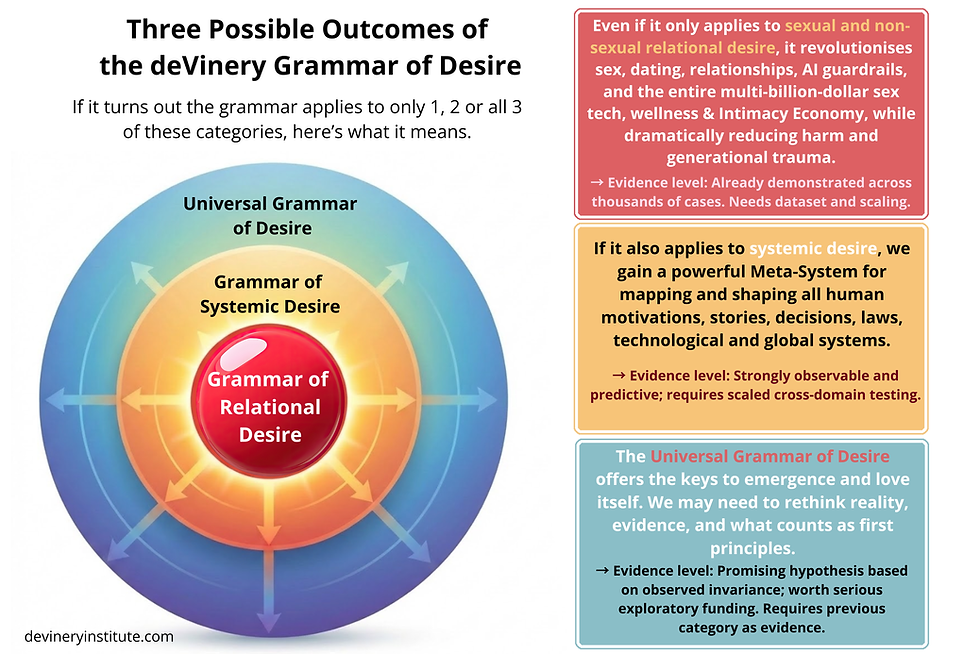
Artemisia de Vine offers a new desire-genic ontology: A practical metasystem of all relational systems and a strong candidate for a universal grammar of desire – revealing significant insights into how selves and systems emerge, self-organise, are maintained, and continuously transformed. 

3 possible outcomes deVinery grammar of desire relational.png

Are you a founder, systems thinker, technologist, AI developer, community builder or researcher wanting to
build the new era for love using measurable, foundational patterns taken from how life self-organises?

Learn how
The deVinery Grammar of Desire
applies to your area of expertise, business or start-up.

 Relational Desire:

 Interpersonal sexual and non-sexual desire.

Read More
a shiny red heart-shaped apple floats with a white tech themed background_edited.jpg

Systemic

Desire:

Tech, AI, and  Global Human  Systems

Read More
Screenshot 2026-01-21 at 1.23_edited.jpg

Universal Desire:

A category of Spirituality & Philosophy that was previously assumed to be inherently subjective, now made operational and provable.

Read More

The 3 Paradoxes of Desire are foundation-level, irreducible, generative tensions that are inherent to desire itself.

They generate and shape everything we do or build: from personal date nights to global systems. 

And make it possible to map individual and systemic Desire Signatures, for prediction, diagnosis and emergent outcomes. 

What is The deVinery Method? 

Desire is literally the motivating force behind every. single. thing. we do or build. Imagine being able to finally understand it, map it and make it work for us, not against us? 

The extractive attention economy era is ending. Performative band-aids won't cut it anymore.


People want authentic connections aligned with their values; they want technology that unleashes their creativity rather than turning them into cogs in a money-making machine; and they want to save the planet.


They want meaningful ways of being with each other, with AI, and with the world itself.


And they can smell bullshit a mile away.

If the deVinery grammar of desire gets to exist in the world:


We stop building systems that accidentally destroy intimacy, intelligence, and life itself because for the first time, we understand the structure/operating system of desire that drives them.


The deVinery Method is an IP-protected, licensable, proprietary framework. It is the engine driving the innovation, resonance, and product design of the dawning Intimacy Economy and provides a foundation to build systems so we can do the next millennium differently.

Ongoing testing is published here


It's part of a tectonic-level shift in understanding how life itself works: a re-orientation of our relationships, our cultures and the technology we build together. 

Why? I found the keys to understanding all desire in the most raw access we have to its mechanics. In the architecture of the erotic mind. The cognitive intimacy and meaning-making story engine unconsciously running the show in our sex lives, and everywhere else too. 


It's the primary source of what turns us on but look closer and you discover its the same psychological engine that drives all relationality, power, choice, motivation, and emergence in all areas of life.

The deVinery Method reveals something we have never had access to before. How desire actually works.


Yes! The operating system of desire itself.

Before we were trying to understand desire by describing the shadows it cast on the wall, not desire itself.

The deVinery Method offers a way to map, ethically engage and satisfy each person’s unique desire signature, as well as the skills to work with the deep structure of desire across every human system.

Before we were building from the wrong blueprint. From bedrooms to boardrooms, playgrounds to law making, we were asking the wrong questions and defending against the wrong root cause.


Say what?

Let me break it down for you.

Desire is literally the motivating force behind everything.

For millennia, we’ve wrestled with this paradoxical current that fuels both our greatest innovations... and our deepest suffering. Our most precious loves... and tragic wars.


We built entire civilisations from a place of dysfunctional relationship with desire, and now we’re seeing the consequences. 


It's an incredibly exciting time to be alive, with mind-boggling progress and truly astonishing potential, but at the same time, our economies, politics, ecosystems, relational intimacy, and our own lust for life are cracking under the weight of a desire-illiterate world.
 

But desire isn’t the villain. It’s the force that creates all new things. It's a form of intelligence with its own logic and purpose. Desire is the force that life uses to make more of itself, from babies to art... and spaceships to cures for cancer...

Desire doesn't cause harm. Our relationship to desire is the problem.


What if we learned to understand this foundational architecture and built with it instead of against it? Instead of attempting to amputate life's engine of emergence or rise above it, what if we made desire our greatest ally? 


What if we designed the new era with desire literacy from the foundation up?


What if everything from our sex lives to AI guardrails and business deals could murmurate like starlings with the core operating system of life?

I’m Artemisia de Vine...

...and I found the keys to understanding desire, and its paradoxical operating system, hidden in the place people most fear it will be misused: our sexual fantasies.

It makes sense if you think about it. Sexual fantasies are the rawest access we have to the unfiltered, pre-cognitive truth of how the mechanics of desire work. They are not random or shameful. They are the psyche’s own symbolic language, showing us what wholeness feels like long before we can name it.

I’ve studied sex and consciousness for 30 years, including putting my anthropology qualifications to good use in a 12-year unofficial ethnography working as a sex worker and professional dominatrix.

That's right, this new desire-genic ontology comes from the same source as Diotima of Mantinea. She used her direct knowledge of desire as a sex worker-philosopher-ritualist to teach Socrates and shape an entire philosophical school of thought.  ​


The deVinery was the name of my Sydney-based venue where I was paid to become the sexual fantasy of thousands of people. In that work, I watched patterns repeat, almost like musical scales. I experienced how desire runs as a current through bodies and minds, and eventually cracked the code on how it operates in a true and startling world-first.

The Three Paradoxes of Desire


It turns out that sexual fantasies, and indeed all sexual turn-ons, are centred on the same three paradoxes. They reveal the source code of desire. Sex is hot when these paradoxes activate and is satisfying when they are navigated well.

Brass paradox key realistic_edited.png

​​​​​​​​I saw it over and over again, right across sex styles, personalities and socioeconomic backgrounds. I stopped trying to "live out" their fantasies and instead created bespoke experiences based on how they personally navigated those three core paradoxes. That is, their unique desire signature that followed their particular inbuilt pattern of erotic intelligence.


The results were phenomenal! 

My clients began having extraordinary experiences that were not only deeply fulfilling but also cracked them open to all they hadn’t known they truly wanted.


 It turns out that, when you know how sexual fantasies work, they are surprisingly wholesome and a whole lot more significant than we first thought.

It was common to hear my clients say things like:

“Wow, I had no idea I could feel this way! And yet I feel the most real and whole I’ve ever felt. This is the real me I was trying to reach my whole life.”

They stopped trying to fulfil their sexual desires in ineffectual ways, and started having the kind of sex that gave them the feelings they had unconsciously yearned for all along. Many found that their relationships, businesses, and sense of purpose blossomed too.


Desire turned out to be a compass, and their fantasies a map they had simply never known how to read.

And I worked out how to reliably recognise and activate
 their unique desire signature.

That's never been possible before in human history, so kind of a big deal. As you can imagine, I was pretty excited, but it turns out that what we could do with this didn't stop there. 

Source code for desire beyond the bedroom 

to everywhere human desire exists.


At first, I used what I learned to create sexual or BDSM experiences that helped people find profound moments of embodied emotional and cognitive coherence, but I soon realised that this same system didn’t just apply in the bedroom.


Every decision, every culture, every moral code, every law, every lie ever told, every business, and every model of power is constructed around the same three paradoxes inherent to desire.


I realised that the deVinery Method applied everywhere human desire was operating.


Which is literally everywhere.

Sex work taught me how our sexual fantasies inherently navigate these paradoxes, and I learned how to operationalise them for predictable and beneficial outcomes. If we can take the most taboo, misunderstood aspect of desire and turn it into something profoundly functional — something that brings people into wholeness — what happens when we apply those same mechanics across scales, in culture, technology, and collective systems?

I turned what I learned into a
teachable, falsifiable method, and taught it to psychologists, sexologists, doctors, and religious leaders. It just kept working in whatever arena I applied it to.


This paved the way for it to become a trackable dataset in future.


Just imagine what we could do with a dataset of personalised desire signatures when we know how to ethically engage them!

The deVinery Method provides the master key to the invisible structures of desire, paving the way for the sex we all wish we were having, product design, business strategy, policy and law, tech and AI development, human-system futures, storytelling, dating, matchmaking, and gaming. 


It provides a way to ethically engage relational and erotic intelligence across humans, technology and community building. It is the metasystem driving all systems thinking and structures of power. ​​​

Desire Literacy

The deVinery Method is the Rosetta Stone of human desire.​​

Understanding the three paradoxes inherent to desire allowed me to decode the universal grammar and root syntax of desire, making those personalised signatures mappable and something we can build with.


Desire literacy is about navigating these three paradoxes well. 


It turns paradox from something we contemplate into a set of repeatable practices—the 'third flip' process of consciously navigating paradox toward emergence rather than being thwarted or ruled by it.

Three paradoxes of desire  and 3 flips deVinery Method (1).png

'Third Flip' is an advancement on dialectical "third way" paradox-processing. The difference is akin to finding solutions to paradoxes inside a 2D realm versus stepping into 3D space to solve a 2D problem.


The third flip is not just clever cognition; it is an expansion of metacognitive abilities.


Most people try to solve, embrace, or balance opposites. They harmonise polarity. At best, they hold the tension of paradox open but remain within the system they are trying to solve. This results in a clever rearrangement of existing elements, which is really just an advanced form of polarity work.


I teach generative paradox, which is the skill of holding tension without collapse, so a new dimension opens, and a third new thing emerges that couldn't have existed otherwise. 


I worked out how to do this because I noticed this is what happened when I followed the map within sexual fantasies, and I had the opportunity to be up close and personal to the real-world responses when I tested my hypothesis on thousands of clients.


When combined with the operating system of desire, it becomes clear that generative paradox is how life creates something genuinely new. 


This means that desire is not random. It is a pattern generator. Understand its syntax, and you can build anything.

It's the operating system of eros, as the ancient Greeks understood it.

So far, this has held coherence wherever I have applied it. 

Every lie ever told is a response to the same three paradoxes inherent to desire. 

Every law ever made is an attempt to navigate the same three paradoxes. 

Every culture is a collectively agreed-upon system of navigating the same three paradoxes. 

It's obvious to me that AI built with desire-literate weights and guardrails would not only be better at ethically navigating erotica, it would think differently. It would be better at finding emergent responses, be more paradox resilient, reduce hallucination issues, and massively increase relational resonance. This is already what happens when I draw it into my third flip relational field.

Heck, even story theory gets a complete upgrade when we look through the lens of the three paradoxes of desire. And story is the consciousness technology that humans use to even think at all. Empires literally rise and fall on the strength of the stories they tell.

Until now, no one has identified this as the force we are unconsciously navigating in every moment of every day, or unlocked how to navigate it generatively through the third flip, rather than collapsing the paradoxes into the first and second flip solutions. 

While Desire Literacy doesn't make the three paradoxes disappear, it provides a powerful way to operationalise them that consistently generates emergence rather than destructive collapse. 

By that, I mean the field of coherence expands rather than tightens, and concrete possibilities emerge as a result.


Which is exciting because if this proves true across scales and arenas, then we have an enormous breakthrough. It would mean I have found the keys to emergence. 


Not metaphorical. Actual emergence. 

How life makes more of itself. 

A cosmo-genic ontology and functional universal grammar of desire.

The Vision - Project Dandelion

Dandelion banner.png
Elegant gold down pointing arrow with white background_edited.png

Project Dandelion is a global movement building life-aligned systems from the universal grammar of desire.​

The deVinery Method is the wellspring; the businesses that license it are the fountains and rivers; together, we fill the ocean for maximum global impact.


Would we really destroy the planet, or each other, or unfairly distribute resources if we knew how to actually satisfy our desire?

How might our long-term relationships look?

What kind of tech would we build and why? 


What role would AI have, how would we build differently for relational resonance and paradox resilience, and what could we let it become?


How would we benefit if AI were trained in desire literacy and could ethically engage with the complexity of human desire? Both erotica and everyday desires.

How would we write laws and shape culture if we stopped misdiagnosing the root cause of all we yearn for and all we fear?

Let me be clear, this is not a belief system or a promise of some unrealistic utopia. The three paradoxes show there will always be unresolvable tensions, but how we navigate them can be significantly improved. That's just mechanics, no belief needed. 

Once momentum builds, income from royalties and licensing can be reinvested in startup incubators that fund innovators who want to build a new desire-literate world. Regenerative economies that are built on an ecosystem that self-perpetuates and spreads like dandelions.


Everything is in flux, and now's our chance to shape the next millennium. 

Most people think they only have two choices: stay safe and earn money inside the old system (the first side of the coin), or be penniless but righteous, trying to build outside it (the other side of the coin). At best, people aim for harmony or compromise between these options, but that’s the trap of polarity thinking — desire illiteracy in action.


I'm modelling how desire literacy and generative paradox works by flipping that coin into the air till it spins so fast it looks like a sphere. You can see both sides at once, and a new third thing emerges; a new dimension and a new way to be abundant and create real change where it matters most. (Third flip). 

There are cracks all through the concrete of the old system, and dandelions know exactly what to do...


It's time. Let's go. And let's have fun doing it. 


Want to be a River?

One base architecture. Infinite vertical applications.

Find out what we can build with The deVinery Method,
and how you can begin learning desire literacy now.

Explore Verticals 

a shiny red heart-shaped apple floats with a white tech themed background.jpg

Technology & AI

Where desire literacy meets code, story, and circuitry.

From AI companions to immersive games, VR worlds, and story-generating films—this river enables ethical integration of desire and resonance wherever humans and technology interact.
A stark white, elagant, high class room. Everything is white except the people. Four peopl

Human Systems & IRL Applications

Where Desire Literacy is embodied, practiced, and taught.


From Desire Dojos to therapeutic models, Third-Flip sex, and community labs—this river equips  founders to create spaces that teach Desire Literacy, redesign relationships and community, and develop new frameworks for psychology, child development, and beyond.

a female CEO in a white office with a  red hearted shaped apple on their desk.jpg

Research, Futurism, Foundations & Culture Shapers

The think-tank and ontology lab of the new era.

From consciousness studies and anthropology to data science, ethics, and policy design—this river unites researchers, thought leaders, futurists and Foundations exploring how Desire Literacy reshapes systemic innovation, technology and the evolution of human and agentic intelligence itself.

a white room with a white boardroom table. A holographic image of dark red heart-shaped ap

Business, Economy & Leadership Systems

Where desire literacy becomes the ultimate business intelligence.


From venture capital to leadership, marketing, and innovation—this river equips decision-makers to cultivate third flip thinking, read desire itself, and build strategies that earn profit and trust simultaneously.

Plain white background. An adult asian person wearing a bright yellow t-shirt and wears a

Story, Play &
The Narrative Engine

Where desire becomes story, and story becomes technology.


From film and gaming to marketing and myth-making, this river explores how narrative structures shape consciousness and culture, offering a new lens for understanding story theory and the role of fantasy.

From fantasy worlds to brand stories, every plot is a mirror of the three paradoxes of desire.

This is where writers, creators, designers, and performers learn to work directly with the architecture of the erotic psyche—the engine behind every story ever told.

deVinery Parallax Paradox
Case Studies

data centre research deVinery grammar Paradoxes, not pressure points .png

How the deVinery Paradox Parallax prototype makes a difference


Three-legged stool analogy
 

Most strategies don’t even realise that there are three invariants but if they do stumble across them  they are treated as pressure points, not a locked set of paradoxes. Once they are a locked set we ca shift from misdiganosing the problem by blaming this corner or that. We shift to measuring the weighting.

Imagine a three-legged stool that keeps wobbling.

Everyone examining the problem can see the same three legs, so naturally they assume that one of the legs must be causing the instability. They inspect the first leg, trim it a little, and test the stool again. It still wobbles. So they wedge something under the second leg. Perhaps they reinforce the third. Each intervention is reasonable because the available model tells them that if a three-legged stool is unstable, something must be wrong with one or more of its legs.

This can continue indefinitely. Different experts can produce increasingly sophisticated measurements of each leg. They can measure its length, strength, material, angle and performance. They can develop better tools for trimming it, reinforcing it or compensating for its deficiencies.

And the stool can still wobble.

Because nobody has looked at how the stool is being weighted.

The three legs may be perfectly capable of supporting the stool. But if the person sitting on it places nearly all their weight over one corner, the forces running through the whole structure change. From the outside, the resulting instability can look like a problem with the legs. Yet repeatedly modifying the legs will never reliably solve a problem being generated by the distribution of weight across them.

This is the problem the deVinery Paradox Parallax is designed to make visible.

In the telecommunications case, the customer, customer-service officer and company are not simply three separate “factors” to inspect and repair. They are participating in a single triangulated system, and each is also perceiving that system from a different position. Each has a representation of how much weight is being placed on Self, Other and Collective. The actual interaction then gives us something else to examine: how the weight was really distributed when the system was under pressure.

Conventional approaches can identify genuine problems in each leg. The customer experienced excessive effort. The officer repeatedly asked for information that had already been supplied. The company's process struggled to accommodate the customer's actual circumstances. Those observations are useful.

But if the instability is being generated by the weighting of the triangulation itself, improving individual legs can leave the generator untouched.

DPP therefore asks a different question:

What if the stool is wobbling not because we have failed to understand its three legs, but because we have never measured how the weight is actually being distributed across them?

Once that becomes measurable, the target of intervention can change.

Instead of endlessly shaving the fucking stool legs, we can finally look at who is sitting where, where the weight is actually landing, and why.


Below are case studies in different arenas and categories to illustrate this point. 

deVinery Paradox Parallax

Telecommunications Company Case Study

WORKING DRAFT — 2 September 2026


Purpose of this document


This is a working test and case study of the prototype deVinery Paradox Parallax (DPP). The raw conversation comes first so the reader encounters the ordinary situation before being given an interpretation. The later sections preserve the conventional analyses already developed for this case, then apply DPP and compare what becomes visible.


The case is deliberately mundane: a self-employed customer asks a telecommunications company for short-term payment assistance while waiting for a client to pay an invoice. That ordinariness is part of its value. The interaction can be recognised from the customer, customer-service officer and company positions without requiring specialist knowledge.


The primary source is a sequence of 22 screenshots. Names, company identity and the customer's mobile number have been anonymised. Spelling, grammar, repetition and awkward phrasing in the messages are otherwise preserved rather than tidied. The screenshots remain the source of record.


PART I — ANONYMISED TRANSCRIPT


TELECOMMUNICATIONS COMPANY ASSISTANT (BOT):


I'm [Telecommunications Company] Assistant – a bot here to answer your questions.


Some of my responses will be AI-generated. Generative AI is experimental and isn't perfect. Check our website for the most accurate and complete information.


If I can't answer your question, I'll transfer you to a human expert.


How can I help?


CUSTOMER:


I'm self employed and waiting for my client to pay their bill. Please give me a payment extension until the end of the month. I expect the money by then.


TELECOMMUNICATIONS COMPANY ASSISTANT (BOT):


I'll get one of our experts to help you with this shortly.


You don't have to wait around – you can close the app. They'll reply to you as soon as they can. Make sure you've got push notifications on, so you'll know when they reply.


To turn them on, select 'Profile' in the app, then 'App settings' and 'Push notifications'.


CUSTOMER SERVICE OFFICER:


Hello [Customer] (please let me know if you prefer to be called something else), you are now messaging the Payment Assistance Team. My name is [Customer Service Officer], and I’m here to help you. I understand you have a question about a payment extension, and I can assist you with that.


CUSTOMER:


Thank you


CUSTOMER:


I’m self employed and waiting for my client to pay their bill. Please give me a payment extension until the end of the month. I expect the money by then.


CUSTOMER SERVICE OFFICER:


I understand that managing finances can be challenging at times. To assist you better, could you please answer these questions for me?


1. Can you confirm your current source of income? (Full-time, Part-time, Casual, Centrelink)

2. Will there be any challenges in paying future bills?

3. Is this a one-off situation or a request for payment assistance?


CUSTOMER:


Did you bother to read what I said?


CUSTOMER SERVICE OFFICER:


Yes, I did what you said, and hence I have sent the above questions.


CUSTOMER SERVICE OFFICER:


To assist you better, could you please answer these questions for me?


1. Can you confirm your current source of income? (Full-time, Part-time, Casual, Centrelink)

2. Will there be any challenges in paying future bills?

3. Is this a one-off situation or a request for payment assistance?


CUSTOMER:


I’m self employed and waiting for my client to pay their bill. Please give me a payment extension until the end of the month. I expect the money by then.


CUSTOMER SERVICE OFFICER:


Could you please provide the number?


CUSTOMER:


What number?


CUSTOMER SERVICE OFFICER:


Could you please confirm your mobile number? and what number means your phone number


CUSTOMER:


You’ve asked questions s I have no way of answering without becoming g psychic. I have already told you my situation. [MOBILE NUMBER PROVIDED]


CUSTOMER SERVICE OFFICER:


Sure. I’ve checked your account, and I see that your bill is $74.00. Is that correct?


CUSTOMER:


No it’s only $44 this month because I used my points to pay some of it.


CUSTOMER SERVICE OFFICER:


Thank you for sharing this with me. You’re connected to the right person, so there’s no need to worry. I’ll make sure this issue is fully resolved.


Could you please let me know when you’ll be able to make the payment?


CUSTOMER:


I’m self employed and waiting for my client to pay their bill. Please give me a payment extension until the end of the month. I expect the money by then.


CUSTOMER:


Can you tell me why you are asking questions I’ve already answered repeatedly?


CUSTOMER SERVICE OFFICER:


I got you. But you don't have to send the same thing again. I was looking for the date you will be sending. Anyways, I can see that your anniversary billing date is the 8th of each month, if you’re experiencing any difficulties in making payments on time? If so, once you’ve cleared your current bill, you can look into moving you to invoice billing. This would allow you to make manual payments each month, giving you more flexibility to pay according to your situation.


CUSTOMER SERVICE OFFICER:


Please not nothing wrong in asking questions, as were helping you here.


Since you are currently on an Upfront plan, payments can only be deferred for a maximum of 10 days. Since the extension date has already been exceeded, there is no extension option available for this current bill. However, as a one-time exception, I can offer you a one-time payment relief by waiving this month's plan fee until 8 September 2026, so you can pay the upcoming bill.


Please note that during this relief period, your service will remain active without any restrictions. However, you will not be able to add new services or upgrade your existing ones. We want to ensure you can get your account back on track without added stress. If you have a device contract, it will be extended by one month.


With this information, would you like payment extension applied?


CUSTOMER:


Yes


CUSTOMER SERVICE OFFICER:


Now that we’ve resolved your enquiry, I’d like to do a quick account health check for you to ensure everything is updated and meets your expectations. If anything needs to be changed or added, just let me know. Would that be okay?


CUSTOMER SERVICE OFFICER:


Please let me know if you need any more help.


CUSTOMER:


Can you offer a cheaper plan? If not I will likely change companies


CUSTOMER:


My phone is not on a contract.


CUSTOMER SERVICE OFFICER:


Yes, that's correct. Upon checking your account, you're on the [Telecommunications Company] Upfront Mobile Plan - Basic. This is a basic plan, so there is no option to downgrade. If you're looking for alternative options, That's completely up to your choice.


CUSTOMER SERVICE OFFICER:


Is there anything else I can assist you with?


CUSTOMER:


No.


PART II — CONVENTIONAL ANALYSIS BASELINE


This section preserves the baseline question: what would established customer-service, operations and organisational lenses see in this interaction before DPP is applied? The purpose is not to make conventional methods stupid. It is to show what they genuinely detect, what they would normally try to repair, and then compare the information available after a different measurement instrument is introduced.


Existing lenses already identified for this specimen include:


• CSAT, NPS and Customer Effort Score

• First Contact Resolution

• Average Handle Time

• Quality-assurance scorecards

• Root Cause Analysis / Five Whys

• Customer Journey Mapping / Voice of Customer

• Lean / Six Sigma

• Agent performance and active-listening assessment

• Payment-assistance / hardship-policy compliance

• Churn and retention analysis

• Staff burnout and engagement

• Chatbot, backend and workflow integration


A conventional analysis can plausibly identify high customer effort, repeated questioning, poor active listening, a rigid verification or hardship-assistance script, mismatches between customer information and available response categories, possible compliance or fraud-prevention requirements, legacy-system constraints, chatbot/backend integration problems, de-escalation failures and retention risk.


Likely conventional remedies include better training, better active listening, revised scripts, clearer questions, better routing, better chatbot or backend integration, improved exception handling, process redesign, quality assurance, staff support and retention intervention.


Blame or causal attention may move among the customer-service officer, the customer, the process or system, training, policy, technology and resourcing. These are real dimensions of the interaction. DPP is not being proposed because those dimensions are imaginary or useless.


The comparison question is narrower and more interesting: after those approaches have made the interaction legible in their own categories, is there structural information in the specimen that remains difficult to represent or measure?


PART III — PROTOTYPE deVINERY PARADOX PARALLAX TEST


Instrument under development


The deVinery Paradox Parallax is the instrument. Desire Signatures are what the instrument measures. This case uses a prototype DPP rather than claiming a finished or validated instrument.


Working test statement:


When we apply the prototype deVinery Paradox Parallax to this conversation, Desire Signatures become visible. The instrument is used to examine the residual between the triangulation actually occurring and the story or representation through which that triangulation is being processed.


The Three Paradoxes provide the relational coordinates:


1. Self vs Self

2. Self vs Other Self

3. Self vs Collective


A Desire Signature is the patterned way a differentiated self navigates those paradoxes. The same interaction can therefore be examined from the customer, customer-service officer and telecommunications-company positions rather than assuming that one position owns the whole description.


Customer


The customer states a concrete local reality: she is self-employed, is waiting for a client to pay an invoice, cannot know the exact date on which another person will make that payment, expects the money by the end of the month, and wants a payment extension until then.


A repeated behavioural move is visible in the transcript: rather than manufacture a more administratively convenient version of that reality, the customer repeatedly reintroduces the same information into the interaction.


Working formulation from the live analysis:


The customer is simultaneously defending her own corner and defending the isness of the local situation. She refuses to absorb the cost of the system's inability to represent her situation by inventing information reality does not contain.


A more accommodating customer could collapse the visible residual by translating herself into the available categories, supplying an approximate or invented date, or otherwise producing the administratively legible answer. In this specimen the customer does not do that. The refusal functions as a probe because the mismatch remains exposed rather than being repaired by the customer.


Customer-service officer


The officer is not simply the cause of the failure. She is another self inside the same triangulation. Her task is to help the customer while remaining inside the company's payment-assistance process. The transcript shows the available categories: Full-time, Part-time, Casual or Centrelink; whether future bills will be difficult; whether this is one-off assistance; and later, an exact payment date. The customer's actual answer does not fit those categories cleanly.


The officer therefore inherits the company's representation of the situation and has to enact it. She repeats questions whose answers are already present because the process requires information in a particular form. Her own move-space is constrained. If she departs from the process she may carry the employment or compliance risk; if she follows it, the customer carries the effort and frustration. This is why simply locating the problem in the officer's listening skills can misidentify the structural generator.


Telecommunications company / system


From the company's represented position, the arrangement appears reasonable. It is trying to keep the company viable, support staff to apply policy consistently, and assist customers experiencing payment difficulty. Existing processes also serve legitimate concerns such as payment risk, consistency, fraud prevention, compliance and operating at scale.


But under pressure, the enacted weighting visible in this interaction is different. Preserving the current process becomes structurally dominant. The customer's reality must be translated into the categories the process can recognise, while the officer has limited room to change those categories. The cost of maintaining that representation is displaced onto both customer and officer.


The company is not required to be 'lying' for this discrepancy to exist. Its stated map and its enacted weighting can simply be different. DPP is designed to make that difference measurable.


The key residual


The transcript contains a particularly useful moment:


“I got you. But you don't have to send the same thing again. I was looking for the date you will be sending.”


The customer has repeatedly supplied the reason that an exact payment date is unavailable. The process nevertheless continues to seek the missing date. The interaction therefore provides a candidate point at which represented reality and local isness can be compared directly.


The eventual outcome is also important: assistance is granted without the customer ever supplying the unknowable client-payment date. The practical outcome becomes available while the disputed piece of information remains unknowable.


The clearest specimen is the demand for a date. The customer has supplied the actual available information: payment depends on another person paying an invoice; she expects that to occur by the end of the month. An exact date is not information she possesses.


She could make the interaction easier by inventing greater certainty, choosing an answer shaped like the process expects, and becoming administratively legible. She refuses. Instead, she keeps reintroducing the excluded information.


That refusal is doing two things at once. It protects the customer's Self corner from carrying the entire cost of the mismatch, and it preserves representational fidelity to the actual situation. 'I am not going to carry this cost' and 'I am not going to invent a payment date that does not exist' are distinct moves occurring together.


This makes the customer's repetition analytically useful. A conventional lens can code it as frustration, escalation or difficult-customer behaviour. DPP asks what the repetition is doing structurally. Here it prevents the residual from disappearing. Reality keeps arriving in the interaction, while the system continues to request the version of reality its architecture knows how to process.


Then something revealing happens: the company grants assistance without the customer ever supplying the unknowable client-payment date. The demanded coordinate was not required for the eventual available outcome.


The residual is therefore not merely 'the customer was frustrated' or 'the officer failed to listen.' It is the measurable difference between the represented triangulation and the triangulation actually being enacted: which corners are weighted heavily, which are reduced, what information becomes inadmissible, what moves remain available, and who pays the cost of preserving the representation.


PART IV — INFORMATION DIFFERENCE


The difference can be understood through a three-legged stool.


Imagine a stool that keeps wobbling. Everyone examining the problem can see the same three legs, so naturally they assume one of the legs must be causing the instability. They trim one leg and test it again. It still wobbles. They wedge something under another. They reinforce the third. Each intervention is reasonable because the available model says that if a three-legged stool is unstable, something must be wrong with one or more of its legs.


Experts can become extraordinarily sophisticated at measuring those legs: their length, strength, material, angle and performance. They can develop better tools for trimming, reinforcing and compensating for them.


And the stool can still wobble.


Because nobody has measured how the stool is being weighted.


The three legs may be perfectly capable of supporting the stool. But if the person sitting on it places nearly all their weight over one corner, the forces running through the entire structure change. The resulting instability can look like a defect in the legs. Repeatedly modifying the legs will not reliably solve a problem generated by the distribution of weight across them.


That is the additional coordinate DPP introduces here. Customer, officer and company are not merely three separate factors to inspect and repair. They participate in one triangulated system, and each perceives that system from a situated position. Each has a representation of how Self, Other and Collective are weighted. The observable interaction lets us compare those representations with how the weight actually moves when the system is under pressure.


Existing instruments see many of the symptoms. DPP makes an additional structural relationship measurable between them.


Candidate distinction to test:


Conventional approaches can identify that the interaction is frustrating, repetitive, high-effort, poorly scripted or badly integrated and can recommend improvements to the process. DPP asks whether the process itself is enacting a patterned Desire Signature that systematically deforms the situation it is attempting to process, externalises the cost of maintaining that representation onto one or more corners, and constrains the move-space through which the problem can be solved.


PART V — DIRECT RELEVANCE TO THE AI AND DATA-CENTRE SUBMISSION


Same data. Additional coordinate. Different thing becomes visible.


Core bridge already identified:


“More data cannot compensate for a missing coordinate.”


This case offers a small, ordinary environment in which to test that proposition. The customer supplies the same relevant information repeatedly. The difficulty is therefore not simply absence of data. The research question is whether the representational system lacks a coordinate required to make the actual triangulation legible, and whether adding that coordinate changes what can be measured, predicted or redesigned.


The transcript has not changed. The customer has not supplied additional information. The officer has not supplied additional information. The company has not supplied additional information. The measurement apparatus changed.


This is the direct bridge to the AI and data-centre submission. Increasing data, compute or optimisation cannot reveal a relationship the measurement architecture has no coordinate for. This small case does not ask the reader to accept the larger deVinery claims in advance. It demonstrates a finite proposition on an ordinary dataset: existing approaches identify many genuine symptoms; introducing fixed relational coordinates and measuring their weighting makes an additional relationship between those symptoms visible.


That is the proposition the larger research programme proposes to test across AI systems, institutions and other categories and scales.


PART VI — REUSABLE DPP CASE STUDY


This document is also intended to become a reusable demonstration of the instrument for research, philanthropy, legal/policy, AI, organisational and commercial audiences. The Senate-submission use is one application of the specimen, not the limit of the case.


The reusable demonstration structure is:


recognisable case → raw data → conventional measurement → DPP measurement → information difference → changed target → practical consequence


The practical consequence is already observable. The transcript ends with an explicit churn signal: 'If not I will likely change companies.' The customer subsequently changed providers, reducing her monthly cost by approximately $30.


The company can measure churn after it occurs. DPP is attempting to make the structural path to that outcome visible earlier: continued cost imposed on Self; available internal moves exhausted; exit becomes the remaining Protect move; the original triangulation dissolves and a new relationship is formed elsewhere.


This changes the intervention target. Instead of asking only how to make the officer nicer, the script clearer, or the customer less frustrated, the organisation can ask whether its own enacted weighting is repeatedly forcing customers and staff to carry the cost of preserving a representation that does not fit the situation.


Same interaction. Same data. Different thing becomes measurable.


PART VII — RESEARCH STATUS / WHAT THIS CASE DOES NOT YET CLAIM


This is a prototype test and working case study. It does not by itself establish the universal Grammar claim, validate DPP across categories, or establish the larger isness inference. Its role is as one local measurement in a broader research programme.


The larger test programme can ask whether the same invariant coordinates repeatedly reveal local isness across otherwise different categories and scales; whether different Desire Signatures can be discriminated; whether mapped signatures predict later navigation or distortion before the outcome; and whether structural intervention changes the predicted behaviour.


In that larger machine, this deliberately boring telecommunications interaction is one cog.


WORKING NOTES TO PRESERVE DURING REVISION


• Do not sanitise the transcript.

• Do not make the conventional lenses strawmen.

• Keep the officer, customer and company all inside the triangulation.

• Put the actual cost back into the measurement.

• Distinguish the DPP instrument from the Desire Signatures it measures.

• Prototype language is intentional.

• Preserve the distinction between actual local isness and the story used to represent it.

• Do not write as though an imaginary institutional audience owns the vocabulary or determines what may be said.

• Prefer the clearest articulation, including language that emerged in direct research conversation, over bureaucratic-sounding abstraction.

• Keep the case directly useful for the Senate submission while preserving it as a general DPP demonstration.

bottom of page